
Approximate annual cost to UK local authorities reported by Defra in March 2021.
Defra · 30 March 2021 ↗The cost of cigarette & gum litter
Collect it before
it spreads.
Small litter creates a substantial, recurring clean-up burden. Convenient disposal gives people a way to help prevent it — and can help cleansing teams make better use of their time.
Published UK estimates
Public money. Repeat cleaning.
Estimated annual UK council removal cost quoted by Defra in July 2023, and repeated by councils in 2025.
Defra · 6 July 2023 ↗Sheffield City Council · 8 October 2025 ↗These estimates have different publication dates. They are not a current combined bill, individual council budgets or predicted savings from a Smartstreets scheme.
City of London · Historical economic-benefit model
Same quantity. Different collection methods.
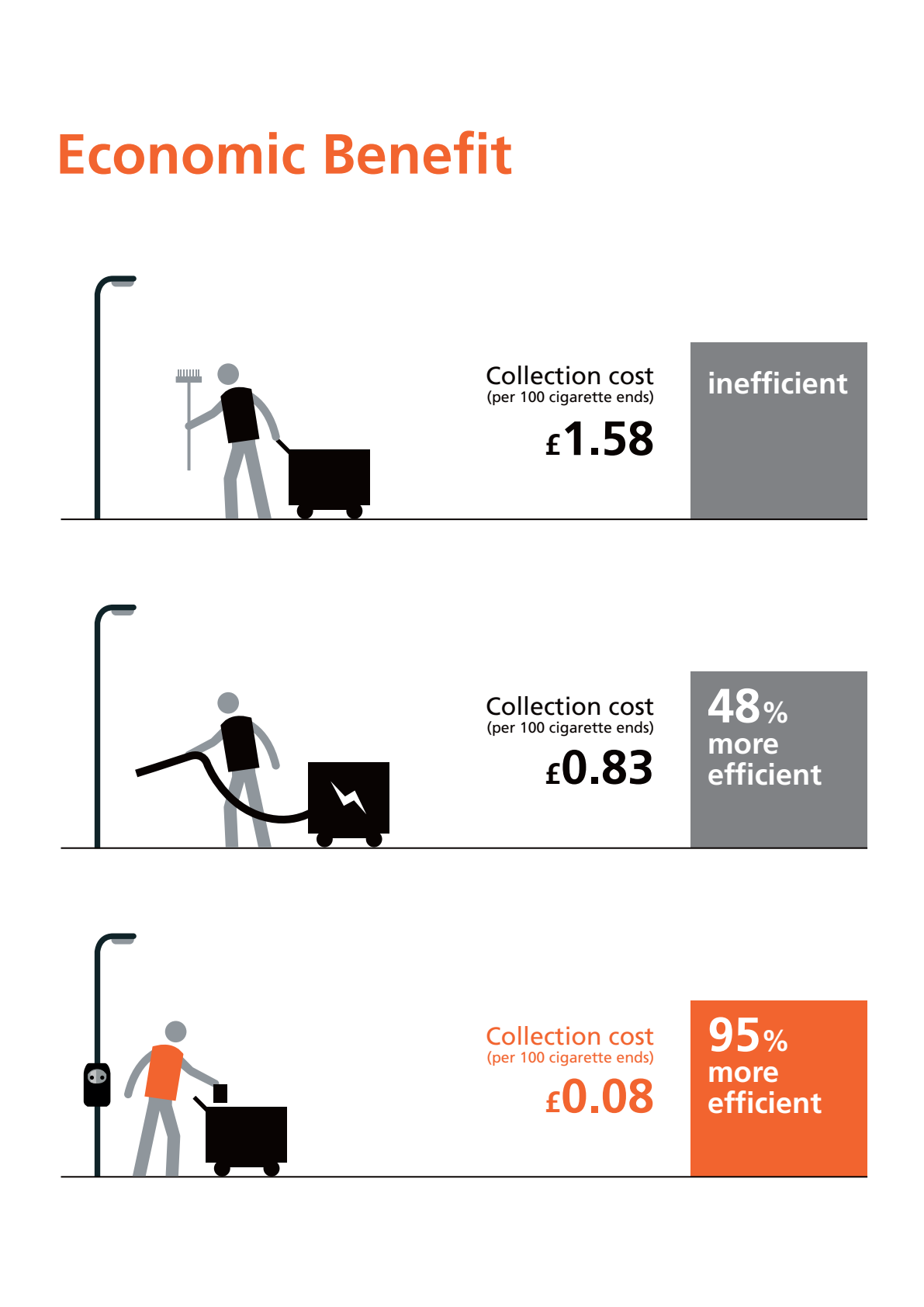
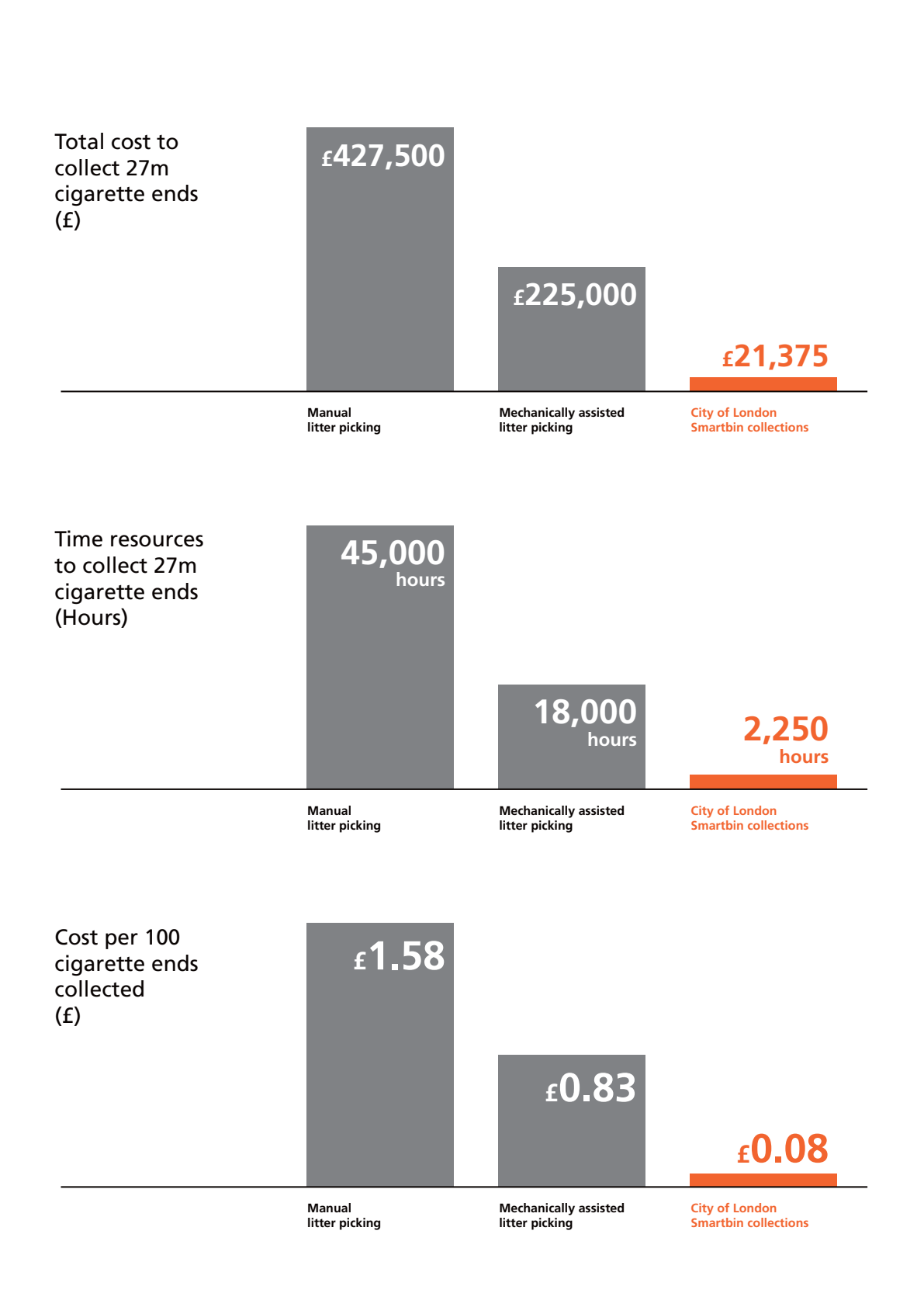
The case study compares the resources needed to collect 27 million cigarette ends — the quantity reported as collected by 633 Smartbins in 2012. Its central point is practical: collecting waste from a container is different from finding and removing it from pavements, cracks, gullies and drains.
| Modelled collection method | Time per 100 ends | Hours for 27m ends | Implied collection cost | Cost per 100 ends |
|---|---|---|---|---|
| Manual picking & sweeping | 10 minutes | 45,000 | £427,500 | £1.58 |
| Mechanically assisted / manual picking | 4 minutes | 18,000 | £225,000 | £0.83 |
| Collection from full Smartbins | 30 seconds | 2,250 | £21,375 | £0.08 |
Historical modelled comparison, not an audited cash saving or present-day quotation. Per-100 figures are rounded as published.
Read the assumptions and what the comparison covers
The report uses £9.50 per hour for manual picking and Smartbin collections, and £12.50 per hour for mechanically assisted collection. The implied costs are calculated from those hourly rates and the assumed collection times.
It compares collection labour for the same quantity of cigarette ends. It does not establish whole-scheme net savings after equipment purchase, installation, route planning, transport, disposal and other operating costs. Gum removal is a separate task and is not included in these cigarette-end scenarios.
Local outcomes depend on footfall, disposal behaviour, network coverage and servicing. A site-specific review and measured pilot are the right starting points for a current budget.
The opportunity is to prevent avoidable work.
Put disposal where people can find and use it. Then measure litter on the ground, use of the facilities and servicing time. Prevention and efficient collection can complement the essential work of cleansing teams.
Plan a scheme around your locations →From the original report
The comparison, as published.
The report’s illustrations and charts show its three collection scenarios. Select an image to view the original graphic at full size.
International context
A wider clean-up burden.
WHO’s May 2022 analysis estimated annual tobacco-product-waste clean-up costs of roughly US$2.6 billion in China and US$766 million in India.
These are modelled country estimates. WHO apportioned total litter costs to tobacco-product waste; for China and India it also estimated total litter costs using comparable countries. They are not audited spending totals and cover tobacco-product waste more broadly than cigarette ends.
WHO · 31 May 2022 · Figures and methodology ↗No consistent, authoritative combined worldwide total for cigarette and chewing-gum clean-up was identified. We use dated, scoped estimates rather than extrapolating a global bill.
Start with the places that need it most.
Review your hotspots, existing posts and servicing routes. We can help you specify convenient disposal facilities and a practical way to assess their impact.
Explore council schemes →Discuss your locations →