
Cigarette litter is often an infrastructure problem.
The usual response is another awareness campaign, another poster or another reminder not to litter. Those things can help, but they rarely create lasting change if someone finishes a cigarette and there is nowhere convenient to put it.
Location matters more than messaging. The most effective disposal points sit exactly where smokers naturally congregate: outside offices, transport hubs, pubs, shopping streets and other known hotspots. Existing lamp columns and signposts make it possible to create far denser disposal networks without filling the pavement with more freestanding street furniture.
“Don’t ask people to change their behaviour first. Design the environment so that doing the right thing becomes the easiest option.”
Smartstreets design principleA project that proved the approach.
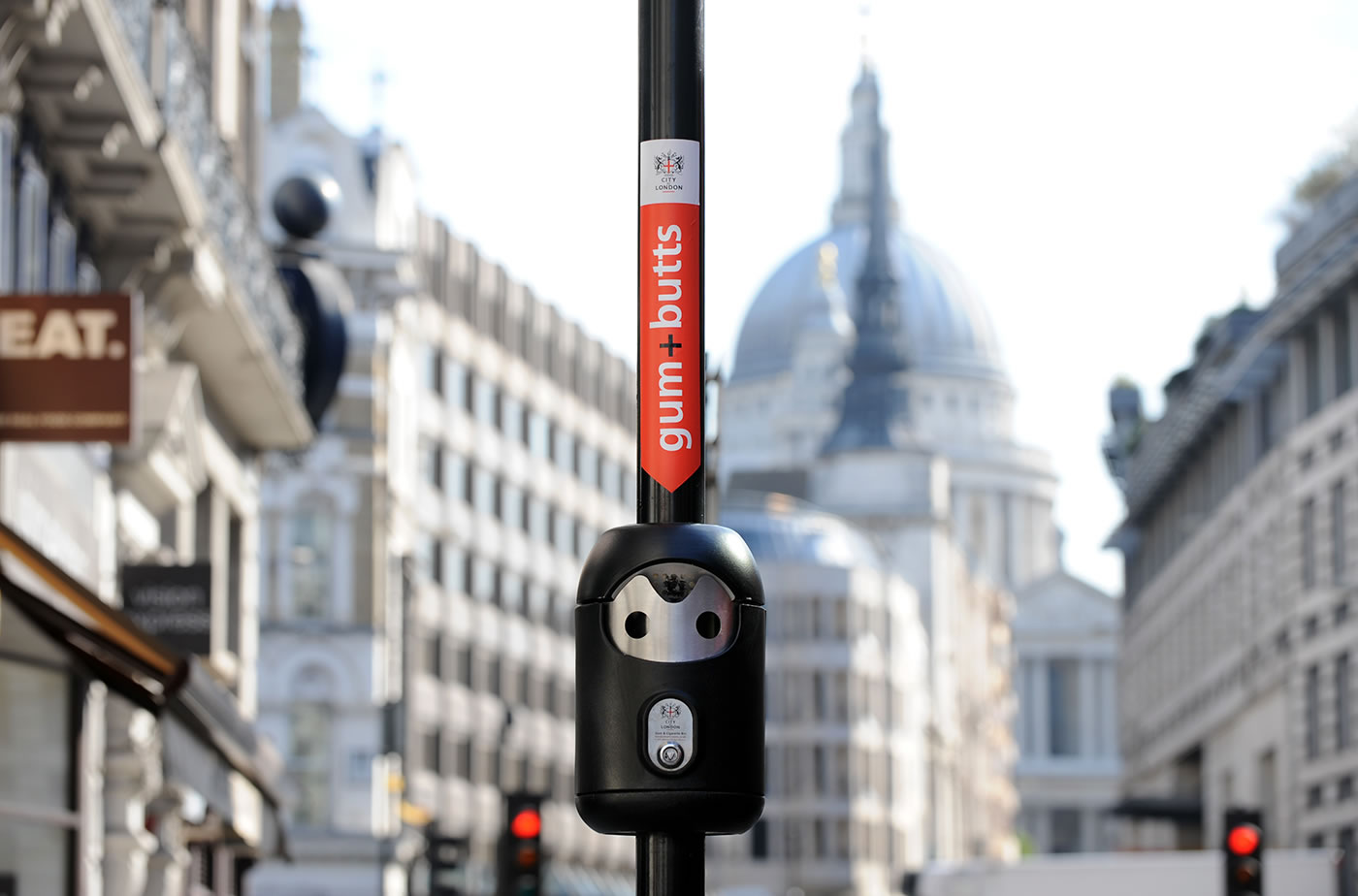
City of London
The City faced persistent cigarette-litter hotspots around offices, transport routes and building entrances. Rather than rely on large freestanding bins, a network of Smartbins was mounted directly to existing lamp columns and signposts.
The programme developed into a long-term network supported by repeat orders and wider engagement. The published case-study material reports a 64% reduction in smoking-related litter and more than 27 million cigarette ends collected annually. View the published evidence ↗
A five-step plan for a council with a limited budget.
Identify the hotspots
Walk the town with the cleansing team. Speak to cafés, pubs, office managers and transport operators. Find the places staff sweep repeatedly.
Understand the behaviour
Ask why cigarette ends are being dropped there. Usually the answer is simple: the disposal point is not within a few steps of where the cigarette is finished.
Build a network, not isolated bins
A handful of equipment in convenient installation locations will not change behaviour. Coverage and predictability are what create a usable system.
Start small and measure
Trial the worst hotspots first. Measure cigarette ends on the ground and cleansing time before installation, then repeat the measurements after the intervention.
Support infrastructure with communication
Awareness works best when people actually have somewhere convenient to act on the message.
Three costly mistakes to avoid.
1. Putting bins where there is space, not where people smoke.
Follow behaviour, not convenience. A pristine bin 30 metres from the hotspot is not solving the problem.
2. Buying on purchase price alone.
Whole-life value matters: durability, servicing time, ease of emptying, installation cost and replacement frequency all affect the real cost.
3. Treating cigarette litter as a one-off project.
Smoking patterns change. Successful schemes are maintained, reviewed and expanded as evidence develops.
The hidden costs are bigger than an untidy pavement.
Cigarette ends are small, numerous and slow to remove. They accumulate in cracks, kerbs and drains and require repeated manual or mechanical cleansing. Filters are made from cellulose acetate and can persist in the environment for years. Rain can carry them into drains and waterways.
There is also a place-quality cost. Clean streets feel safer, better managed and more welcoming. Once litter becomes normalised, it can encourage more littering. Prevention therefore affects cleansing efficiency, environmental quality and public perception at the same time.
The real innovation is designing around people.
Smartstreets started with a question: how can a town provide enough disposal points without filling the street with more objects? Lamp columns and signposts are already strong, positioned along pedestrian routes and maintained as part of the public realm. Using them as mounting points reduces extra clutter and makes denser coverage practical.
The same philosophy applies beyond cigarette litter. Good cycle parking should make secure, orderly parking easier. Gum disposal should be engaging and obvious. The product is only successful if it improves what people actually do.
What more than two decades of experience teaches.
Most people want to do the right thing when the right thing is easy. Small design details matter. The people who empty, install and maintain equipment are often the best source of product insight. Long-term relationships are more valuable than one-off sales, and repeat business is one of the clearest tests of whether an intervention works in the real world.
“Cleaner streets aren’t created by asking people to be perfect. They’re created by understanding human behaviour and designing places that make the right choice the easy choice.”
Smartstreets