
Support local expertise with convenient disposal.
Cigarette litter calls for a combination of cleansing, communication, appropriate enforcement and convenient disposal. Council teams understand how those elements work locally. Our contribution is to help them review where dedicated facilities could make disposal easier and support the work already under way.
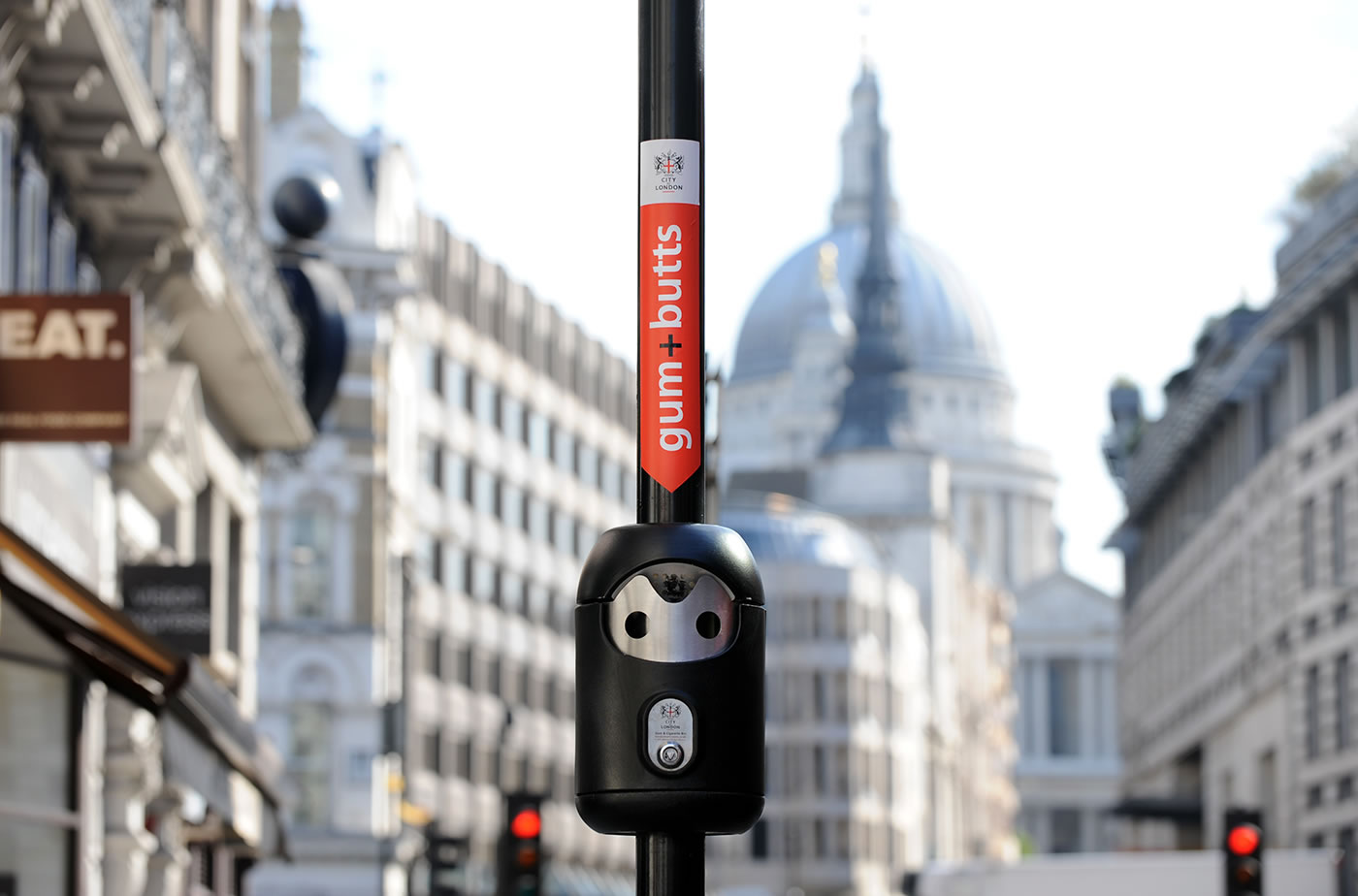
One lesson we have learned from council teams is that location and communication need to work together. Their knowledge of office entrances, transport hubs, pubs and pedestrian routes helps identify where disposal points are most useful. Suitable existing lamp columns and signposts can provide mounting opportunities while keeping additional street furniture to a minimum.
“Start with the people who know the place. Then make considerate disposal as convenient as possible.”
Smartstreets design principleLearning from the City of London.
City of London
The City of London’s programme demonstrates what a coordinated approach can achieve. Its teams developed and managed a network of Smartbins on existing lamp columns and signposts, bringing dedicated disposal points into the street scene around offices and busy pedestrian routes.
The programme developed into a long-term network, supported by the City’s ongoing cleansing, servicing and public engagement. The published case-study material reports a 64% reduction in smoking-related litter and more than 27 million cigarette ends collected annually. These are historical results from that scheme, rather than a forecast for other locations. View the published evidence ↗
A five-step plan for a council with a limited budget.
Identify the hotspots
Walk the town with the cleansing team. Speak to cafés, pubs, office managers and transport operators. Find the places staff sweep repeatedly.
Understand the behaviour
Ask why cigarette ends are being dropped there. Consider the availability and visibility of suitable bins, pedestrian movements, smoking patterns and existing communication. Local observation helps distinguish a provision gap from other issues.
Build a network, not isolated bins
Use the team’s local knowledge to identify gaps in coverage and opportunities for predictable placement. A coordinated network can support disposal more effectively than individual installations considered in isolation.
Start small and measure
Trial the worst hotspots first. Measure cigarette ends on the ground and cleansing time before installation, then repeat the measurements after the intervention.
Support infrastructure with communication
Build on the council’s existing communication and engagement. Clear messages and convenient facilities can reinforce each other.
The hidden costs are bigger than an untidy pavement.
Cigarette ends are small, numerous and slow to remove. They accumulate in cracks, kerbs and drains and require repeated manual or mechanical cleansing. Filters are made from cellulose acetate and can persist in the environment for years. Rain can carry them into drains and waterways.
There is also a place-quality cost. Clean streets feel safer, better managed and more welcoming. Once litter becomes normalised, it can encourage more littering. Prevention therefore affects cleansing efficiency, environmental quality and public perception at the same time.
The real innovation is designing around people.
Smartstreets started with a question: how can a town provide enough disposal points without filling the street with more objects? Lamp columns and signposts are already strong, positioned along pedestrian routes and maintained as part of the public realm. Using them as mounting points reduces extra clutter and makes denser coverage practical.
The same philosophy applies beyond cigarette litter. Good cycle parking should make secure, orderly parking easier. Gum disposal should be engaging and obvious. The product is only successful if it improves what people actually do.
Questions for a joint site walk.
Use these prompts alongside your team’s existing surveys and monitoring:
- Where does cigarette litter repeatedly accumulate, and when?
- What do cleansing staff and nearby businesses observe?
- Are suitable disposal points visible where cigarettes are finished?
- Which mounting locations protect pedestrian access and allow practical servicing?
- What baseline observations could be repeated after installation, allowing for changes in footfall and cleansing schedules?
- Who will review use, servicing needs and any changes to hotspot locations?
Read what the bins are telling you.
A full bin is a useful signal.
A full cigarette bin shows that people are finding and using it. If it regularly fills before the next collection, review the emptying frequency, available capacity or provision of additional bins at that spot.
The aim is to keep that successful disposal point available: act before it overflows, so people can continue to use it.
Make one change. Check the result.
Record when the bin fills, when it is emptied and how much litter remains nearby. Adjust the servicing schedule or provision, then compare similar periods to see whether the change is helping.
Small details. Better everyday use.
Feedback from cleansing teams shapes how we approach fitting, emptying and servicing. Bring your team’s observations; we can help review suitable locations, fixing options and provision for your streets.